What Is an Estate Auction?
What Is an Estate Auction? A Complete Guide for Alaska Families
An estate auction is a public sale where items from a person's estate—furniture, collectibles, vehicles, tools, artwork, and more—are sold to the highest bidder through competitive bidding. Unlike fixed-price estate sales, auctions let market demand determine each item's final price in real time.
Estate auctions are commonly triggered by life events: the death of a property owner, divorce settlements, major downsizing, relocation out of Alaska, or transitions into assisted living. When families need to liquidate an entire home's contents quickly and completely, the estate auction process offers a structured solution that outperforms traditional sales in both speed and results.
Alaska Premier Auctions & Appraisals conducts many estate and downsizing auctions each year for families across Anchorage, the Mat-Su Valley, Fairbanks, the Kenai Peninsula, and remote communities throughout the state.
Estate Auction vs. Estate Sale
Both estate auctions and traditional estate sales liquidate personal property, but they differ significantly in pricing format, buyer reach, and outcomes. Understanding these differences helps families choose the right approach for their situation.
An estate sale operates as a multi-day, in-home shopping event with fixed prices on each item. Shoppers browse the premises on a first-come, first-served basis, and items that don't sell often require donations or disposal afterward. An estate auction, by contrast, is a scheduled event—often online for 5–14 days—where buyers place bids and each lot sells to the highest bidder at closing.
Key differences include pricing transparency (auction bids reveal true demand versus guesswork on price tags), liquidation rates (auctions achieve 90–95% sell-through versus 60–80% at most estate sales), and buyer reach. A traditional tag sale in Anchorage draws local foot traffic, while an online estate auction attracts bidders from Seattle, the Lower 48, and beyond—particularly valuable for specialty items like Alaska Native art or vintage marine equipment.
What Is an Estate Sale?
Estate sales resemble large, organized garage sale events held over 1–3 days inside the home. Items are pre-priced by the family or estate sale companies, with potential markdowns on day two or three to move remaining goods. Shoppers walk through, pay at a checkout table, and take their purchases with them.
The format works reasonably well for everyday household goods. However, drawbacks include heavy foot traffic through the home, constant haggling over fixed prices, limited reach to local buyers only, and the inevitable pile of unsold items left behind when the sale ends.
What Is an Estate Auction?
An estate auction is a structured sale run by a professional auctioneer or auction company where items are sold in lots through competitive bidding. Most modern estate auctions in Alaska are timed online events hosted on digital platforms, though live auctions and hybrid auctions remain options for specific situations.
Buyers register on the auction platform, preview photos and detailed descriptions, and place bids over the bidding period. The system sends automated notices when bidders are outbid, encouraging competing bids that drive prices upward. When bidding closes, winning bidders are legally obligated to pay, typically followed by scheduled pickup over 1–3 days.
Estate auctions usually achieve full or near-full liquidation—critical when a house must be cleared by a specific date for closing or lease termination.
How an Estate Auction Works: Step-by-Step
Understanding how estate auctions work helps families know what to expect from start to finish. While details vary by situation, Alaska Premier Auctions & Appraisals follows a consistent, documented process that families can rely on. Most auctions move from intake to closing within 2–4 weeks.
Step 1: Initial Consultation & Estate Review
The process starts with a free consultation—often on-site at the property in Anchorage or via video and photos for remote locations like Juneau, Kodiak, or Bethel. During this meeting, the auction team walks through the home, discusses goals and timing constraints, and identifies what should or should not be sold.
Experienced appraisers spot valuable items that family members might overlook: Native Alaskan art with provenance, firearms collections, gold and silver, vehicles, commercial equipment, and specialty collectibles. At this stage, the company advises whether an estate auction, a combination of auction and donation, or another approach best fits the situation.
Step 2: Contract, Timeline & Terms
Once the client chooses to proceed, a written agreement outlines commission structure, responsibilities, and an estimated auction schedule. Common timelines include 7–14 days for cataloging and marketing, followed by approximately one week of online bidding.
Clear terms cover reserves (minimum bid thresholds, if any), how unsold items are handled, and when sellers receive their settlement check—typically within 10–21 days after closing. Alaska Premier Auctions & Appraisals provides transparent contracts and encourages clients to ask questions before signing.
Step 3: Sorting, Cataloging & Professional Photography
The team sorts through the estate, groups smaller pieces into lots, and prepares a detailed inventory. Cataloging includes accurate descriptions, condition notes, and any known provenance for items such as artwork, military memorabilia, or vintage firearms.
High-resolution photos—often 10–20 images per high-value lot—allow online bidders from Anchorage to Seattle and beyond to bid confidently without seeing items in person. Better cataloging and photography directly correlate to higher bids and fewer post-sale disputes.
Step 4: Marketing the Estate Auction
Once cataloging is complete, the auction is scheduled with a specific closing date and time. Marketing campaigns drive potential buyers to the listings through multiple channels: the company's website, major auction platforms, email campaigns to thousands of registered bidders, social media promotion, and sometimes niche advertising for specialty collections.
Alaska Premier Auctions & Appraisals maintains robust bidder lists reaching collectors across the country. Strong marketing typically results in more bidders, more bids per lot, and better realized prices—particularly important for high-value items that benefit from national exposure.
Step 5: Bidding Period & Auction Closing
The online bidding window typically stays open for 7–14 days, allowing buyers time to preview lots and place bids at their convenience. Real-time bidding features include soft-close extensions (adding 2–5 minutes per late bid to prevent last-second sniping), proxy bidding where buyers set maximum bids, and automated outbid notifications.
Competitive bidding drives results. A vintage fishing reel estimated at $50 might climb to $450 through competing bids. A firearm listed at $500 could reach $2,200 via 25 bids from collectors nationwide. When the auction closes, each lot is awarded to its highest qualified bidder and binding invoices are generated automatically.
Step 6: Payment, Pickup & Cleanup
Buyers pay promptly after closing—usually within 24–72 hours—using credit card, ACH, or wire transfer. The auction company then organizes scheduled pickup windows, typically spanning 1–3 days following auction day, to remove items efficiently from the property.
Optional services include coordinating shipping for small, valuable items to out-of-state buyers or arranging local delivery for large furniture. After pickup concludes, the home is significantly cleared. Any remaining items are handled according to the agreement: donation, disposal, or left for the family.
Step 7: Final Accounting & Seller Settlement
The auction house prepares a detailed sales report showing each lot, hammer price, buyer's premium, and net proceeds to the seller. Payouts typically arrive within 10–14 business days after closing, once all payments have cleared.
This itemized report serves as official documentation for personal representatives, attorneys, and accountants managing estate records. Alaska Premier Auctions & Appraisals remains available for follow-up questions about specific lots or pricing.
What Items Are Typically Sold at an Estate Auction?
Nearly all types of personal property can be sold at auction, from everyday items to rare collectibles. The auction format works because competitive bidding establishes fair market value regardless of whether family members know an item's worth.
Common categories in Alaska estates include:
- Furniture and home goods
- Tools and commercial equipment
- Sporting goods (fishing, hunting, camping)
- Alaska art and Native carvings (including ivory)
- Fishing and hunting gear
- Firearms (requiring licensed FFL transfers)
- Coins, jewelry, and precious metals
- Vehicles, RVs, and marine equipment
- Vintage outboard motors and bush plane components
Specialty items like ivory carvings, vintage outboard motors, or bush plane components benefit especially from online reach to national collectors. In some cases, real estate can be sold via auction in coordination with real estate professionals and legal requirements.
Important: Reach out before cleaning out or donating items. You may have more value than you realize—our team can identify opportunities you might otherwise give away for free.
Types of Estate Auctions: Live, Online & Hybrid
Today's estate auctions can be conducted in several formats, each with distinct advantages. Alaska Premier Auctions & Appraisals primarily uses online approaches to overcome Alaska's geographic distances and weather challenges.
Live Estate Auctions
Live auctions feature a licensed auctioneer calling bids in real time, typically held at the home or a central venue. The atmosphere is fast-paced and energetic, with bidders raising paddles as prices climb. Results come quickly—everything sells in a single day.
However, live auctions present logistical challenges in Alaska. Weather constraints, limited parking, and travel distances make purely in-person events impractical for many communities. When circumstances align, live auctions create urgency and excitement that can drive strong results for certain estates.
Online Estate Auctions
Online auctions take place entirely on digital platforms, with buyers participating from computers or phones anywhere in the world. This format dominates modern practice—roughly 70–80% of estate auctions since 2018 use online platforms.
Advantages include broad reach beyond local markets, flexible bidding over days instead of hours, and no foot traffic through the home. For Alaska families, online formats prove especially effective at attracting Lower 48 buyers willing to pay shipping for valuable items. Alaska Premier Auctions & Appraisals has built substantial online bidder lists since 2018, benefiting every estate client.
Hybrid Estate Auctions
Hybrid auctions combine live, in-person bidding with simultaneous online participation via webcast. This approach captures the energy of a live event while tapping distant bidders for specialty items.
A typical scenario: a major Anchorage estate where vehicles and equipment sell live on-site with online participation, while household items sell in a separate online-only catalog. This hybrid approach maximizes results by matching the right format to each category of personal belongings.
Benefits of an Estate Auction for Families & Personal Representatives
Settling a loved one's estate carries significant emotional weight alongside practical demands. Professional estate liquidation through auction addresses both by delivering efficient, fair outcomes while reducing family burden.
Speed & Predictable Timelines
Most estate auctions are completed within 3–6 weeks from consultation to payout—critical when selling property with closing deadlines or lease terminations. A typical timeline: consultation May 1, catalog online by late May, bidding closing June 5, proceeds distributed by June 20. Many families choose this predictability over months of repeated garage sales or endless marketplace listings.
Fair Market Value Through Competitive Bidding
Auctions expose estate items to many buyers simultaneously, letting true demand determine the final price. This matters enormously for items where family members can't guess value—obscure collectibles, vintage tools, or Alaska memorabilia. Documented bid histories also provide full transparency, showing exactly how market value was established with no room for disputes among heirs.
Reduced Stress & Family Conflict
A neutral third party handling pricing, marketing, and selling prevents disagreements among siblings or heirs. Auction results are documented and impartial, supporting fair distribution of proceeds. This allows families to focus on grief, memories, and legal decisions while professionals handle the loved one's belongings.
Turnkey Service from One Provider
Full-service auction companies manage everything from sorting and photography to marketing, checkout, and final accounting. This one-call solution proves particularly helpful for out-of-state heirs managing an Alaska property from afar. Alaska Premier Auctions & Appraisals coordinates with attorneys and personal representatives on probate cases, handles remote access properties, and maintains communication throughout the process—even when clients are thousands of miles away.
Common Challenges & Considerations
While estate auctions offer powerful solutions, they aren't perfect for every situation. Understanding limitations helps families make informed decisions.
When an Estate Auction May Not Be the Best Fit
Very small estates consisting only of worn everyday household goods may not justify a full auction. If an estate totals under $5,000 in potential value with no collectibles, antiques, or vehicles, a simple garage sale, donation, or hauling service may be more practical. Reputable estate liquidators will advise honestly when an estate isn't a strong auction candidate—even if that means declining the project.
Legal, Probate & Tax Considerations
Personal representatives must follow Alaska probate law (AS 13.16) and any court orders when selling estate assets. Some estates require court approval before liquidating major assets, particularly real estate or high-value collections. Tax implications include potential capital gains tax on appreciated items—consult a CPA or attorney for guidance specific to your situation.
This article does not constitute legal or tax advice.
Emotional & Sentimental Factors
Take time before cataloging begins to walk through the home and identify items to keep. Label anything that should not be sold—heirlooms, family photos, documents, and personal belongings with special meaning. Feeling conflicted about watching a loved one's estate being sold is completely normal. Professional auctioneers understand this emotional weight and work respectfully with families throughout the process.
Is an Estate Auction Right for You? How to Decide
The choice between an estate auction and other options depends on size, value, timeline, and goals. Consider the following questions:
- Do you need a fast, predictable timeline?
- Is there a significant volume of items to liquidate?
- Are collectibles, vehicles, firearms, or other high-value items present?
- Do you want professional help rather than managing sales yourself?
- Are heirs located out of state or managing the property remotely?
A brief conversation with an experienced auctioneer can usually clarify the best direction within minutes. There's no obligation—just practical guidance based on your specific situation.
Sell an Estate in Alaska with Alaska Premier Auctions & Appraisals
Alaska Premier Auctions & Appraisals is a leading Alaska-based auction company specializing in estates, downsizing, and collections. With deep knowledge of the Alaska market, a robust online auction platform, and an experienced team, we serve clients whether they're in Anchorage or managing a property from out of state.
If you need to settle a loved one's estate, downsize, or liquidate personal property, we're ready to help. Visit our Sell With Us page to submit details about your situation and request a free consultation.
Reach out early—before cleaning out or donating items. You may have more value than you realize, and our team can help identify opportunities and design the best auction plan for your estate.
Online Bidding Options
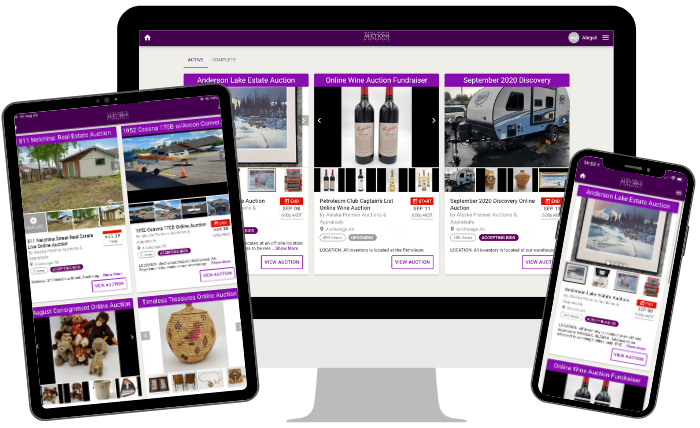
Discover new auctions under the Auctions tab or visit our bidding platform directly at: bid.AlaskaPremierAuctions.com
Download our mobile bidding app for iOS and Android devices. Bid online from anywhere and stay updated on the latest auctions!


Upcoming Auctions

- Jul 21 @ 12:00am AKDT
- Jul 28 @ 6:00pm AKDT

- Jul 21 @ 5:00pm AKDT
- Jul 28 @ 7:00pm AKDT

- Jul 27 @ 12:00pm AKDT
- Aug 2 @ 4:00pm AKDT
- Jul 27 @ 5:00pm AKDT
- Aug 3 @ 5:00pm AKDT